
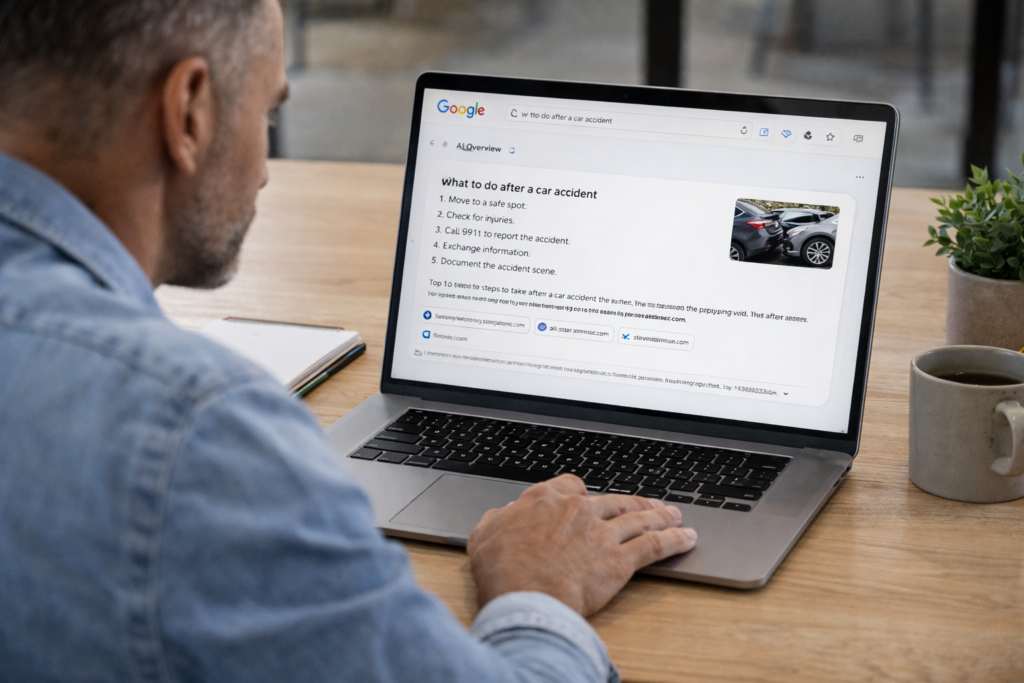
The core shift in legal seo is no longer just about where a law firm website ranks in Google search. It is about whether a firm can still earn attention when AI search, Google’s AI overviews, and other AI platforms begin the conversation with AI-generatedanswers and direct answer experiences before a user ever evaluates the familiar blue links. Google says AI Overviews provide a snapshot with links so users can explore the broader web, which means visibility is still possible, but it now happens through a more layered discovery path.
For law firm owners, managing partners, and agencies focused on law firm marketing, this is not a theoretical change. Google’s Search Central guidance explains that AI features such as AI Overviews and AI Mode affect how content appears from a site owner’s perspective, while Bing now offers AI performance reporting that tracks when pages are cited in AI-generated answers. That combination makes one thing clear: firms now need both classic search engine optimization and stronger AI search visibility if they want durable digital visibility.
This article is written for a single informational intent stage. Its purpose is to explain how AI-drivensearch is changing the rules for legal marketing, why some firms are becoming effectively invisible, and what best practices help legal brands adapt early without abandoning the strengths of traditional seo.
How AI Search Changes the Path to Client Inquiry
In traditional search, a prospective client typed a query, scanned search results, and chose among ranked pages. In AI search, the same person may now see AI summaries, synthesized explanations, or immediate answers generated by AI systems before deciding whether to click anything. Google says users in its AI search experiences are asking longer, more specific, and follow-up questions, which changes both search behavior and the kind of website content that earns attention.
That matters in legal search because many queries involve urgency, uncertainty, and trust. A person exploring family law, a car accident claim, or other sensitive legal questions may prefer a fast summary first and only dig deeper once the answer feels credible. When AI models or AI tools summarize the topic before a click, the firm’s first impression may happen inside an AI interface rather than on its own page.
For law firms, that creates a new competitive layer. It is no longer enough to chase only rankings in traditional search engines. A firm also needs content and technical signals that make it easier for AI search tools to interpret, trust, and surface the brand when users ask natural-language questions.

Why Traditional SEO Still Matters in the Era of AI Overviews
The rise of generative AI does not erase traditional seo. Google’s SEO documentation still emphasizes the basics that help systems crawl, index, and understand a site, and its AI-search guidance explicitly tells publishers to focus on unique, useful, non-commodity content that satisfies visitors. In other words, the old foundation still supports the new environment.
That is why search engine optimization still matters for law firms even when AI decides what to summarize first. Strong pages, clear site structure, relevant internal context, and technically sound publishing increase the odds that a firm’s content can both rank higher in classic results and be used as source material for AI responses. The strategic lesson is not “SEO versus AI.” It is “SEO plus AI readiness.”
The firms that adapt early will not abandon core legal seo. They will refine it. That means treating traditional analytics, rankings, and conversions as part of a broader measurement model that now includes citations, references, and visibility inside AI-generated experiences. Bing’s public-preview AI reporting reflects exactly that shift.
Build Legal Content for Human Readers First
Google’s guidance on succeeding in AI search is direct: create unique, helpful content that fulfills people’s needs. That matters because high-quality content is more likely to serve both human readers and machine systems than copy written mainly to manipulate rankings. For legal marketers, that means every page should answer a real need, not just target a phrase.
This is especially important for practice-driven pages. Content around practice areas such as family law or a car accident claim should not feel like recycled encyclopedia text. It should explain the process, expectations, and next steps in language that matches how prospective clients and potential clients actually ask questions. AI interfaces reward pages that are clear enough to summarize and credible enough to cite.
For that reason, firms should treat each major page as source material. If a page contains real context, accurate framing, and useful explanation, it becomes easier for AI search works environments to parse it. If it is shallow, generic, or over-optimized, it becomes less attractive both to users and to AI systems looking for reliable support.
Why Structured Data and Schema Markup Support AI Search Visibility
Search systems interpret pages more effectively when the content is well organized and machine-readable. Google explains that structured data helps its systems understand content and may support enhanced appearances when used correctly, while its structured-data policies make clear that markup must reflect the visible page rather than invent claims. For legal marketers, that makes schema markup a clarity tool, not a shortcut.
That distinction matters in AI-drivensearch. When services, FAQs, organizations, and page topics are easier to classify, the page becomes easier for search systems to interpret across classic results and AI experiences. Clear, structured content does not guarantee AI recommendations, but it improves the conditions under which a page can be understood, indexed, and potentially cited.
For law firms, this means the goal is not to “hack” AI. It is to reduce ambiguity. A cleaner content model, thoughtful schema markup, and well-labeled sections help search engines connect the firm’s expertise, services, and supporting information more accurately. That strengthens both authority signals and long-term AI search visibility.

Strengthen Technical Foundations Before Trust Erodes
A large part of technical seo remains unchanged because user experience still shapes visibility. Google’s documentation continues to tie SEO success to crawlability, indexability, and content clarity, and Bing’s search guidance emphasizes keeping content relevant and up to date while monitoring performance. A technically weak site makes it harder for both users and systems to trust what they find.
That means a law firm website still needs to be mobile-friendly, logically organized, and easy to navigate. AI features may summarize the answer first, but the click still matters when a user wants proof, nuance, or a next step. If the page loads poorly, buries the answer, or creates friction, the firm loses the advantage even after earning visibility.
Technical discipline also affects how source material is processed. Clean headings, crawlable templates, stable page relationships, and useful outbound links help reinforce context. In legal search, where users often compare multiple firms quickly, a technically clear site becomes part of the firm’s broader digital footprint and trust profile.
Refresh Content Before It Becomes Invisible
One of the biggest risks for law firms is assuming that older content will keep performing without maintenance. Google’s AI-search guidance stresses helpful, satisfying pages, and Bing’s intent-driven SEO guidance highlights keeping content relevant and up to date. In practice, stale content loses competitiveness not only in classic search but also in answer-driven environments that prefer fresher, clearer material.
Refreshing existing content is often more efficient than endlessly publishing new pages. A well-performing article can be rewritten with stronger context, clearer natural language, better entity labeling, and improved relevance to current search behavior. That helps the page remain useful to users while making it easier for AI systems to extract and summarize answers accurately.
The real risk is invisibility by neglect. A page does not have to disappear from the index to stop mattering. If it becomes less trustworthy, less current, or less interpretable than competing sources, it can fade from both ranked results and AI surfaces. That is how good firms become quietly effectively invisible even while their sites remain online.
Use Google’s AI Overviews to Rethink Content Formatting
Google says its AI search experiences encourage longer, more specific, and follow-up questioning. That changes how legal pages should be written. Instead of burying the answer after several paragraphs, firms should make the main issue clear early, then expand with detail, nuance, and supporting explanation. This structure serves both readers and systems without resorting to low-value formatting.
That does not mean turning every page into disconnected bullet points. Legal content still needs depth, persuasion, and context. But it does mean building pages so a system can identify the main answer quickly, while a human can continue reading for richer explanation, caveats, and next steps. The best legal pages now balance summary-friendly clarity with full narrative depth.
For law firm marketing, this is a formatting issue and a strategic one. A page that satisfies AI extraction while still converting prospective clients is more resilient than a page built only for old ranking models. In 2026 and beyond, that balance will likely separate adaptable brands from slower competitors.
Build Stronger Authority Through Mentions, Directories, and Reputation
In AI-driven discovery, authority is not only about position. It is also about whether a brand looks trustworthy across the broader web. Bing’s AI performance framework centers citation visibility, while OpenAI’s search help center explains that ChatGPT search may use providers and targeted queries to produce sourced responses. That means the firm’s reputation across the web can influence discovery in more places than Google alone.
For legal marketing, this makes directory listings, legal directories, and credible media mentions more strategically useful. They reinforce the firm’s legitimacy, provide corroborating context, and strengthen the brand signals that search systems can observe beyond the firm’s own site. A firm with a thin external footprint may have good pages yet still struggle to project trust.
This is where off-site brand building supports generative engine optimization in a practical sense. Mentions from relevant publications, community coverage, and trustworthy third-party profiles can help a firm look more established when AI tools assess source credibility. In legal SEO, authority increasingly lives both on-page and off-page.
Why Weak Pages Lose in AI Search Results
A page can still rank for a keyword and yet perform poorly in AI search results if it lacks substance. Google’s guidance on AI-generated content warns against scaled pages that add little value, and its AI-search guidance emphasizes unique, non-commodity material. That is a direct warning against thin content dressed up as strategy.
This problem shows up often in legal content. Pages that repeat generic legal information, overuse keywords, or mimic competitors without adding fresh insight may have once survived in classic search. In AI search, where systems look for concise authority and usable context, those pages become less attractive as source material. They are present on the web but weak in the moments that matter.
The solution is not more volume. It is more valuable. Better explanation, sharper structure, clearer context, and stronger trust signals make it easier for a page to compete, whether the user sees a ranked listing, an AI summary, or both. That is the practical core of modern legal seo.
Measure What Matters as AI Reshapes Visibility
As discovery changes, measurement has to change too. Bing’s AI reporting now tracks citations and referenced pages in AI-generated answers, showing that visibility can happen before the click. Bing has also argued that impressions, citations, and placement in AI answers can reveal how content is surfaced and trusted even before a site visit.
For law firm owners and agencies, that means traditional analytics alone are no longer enough. Rankings, traffic, and conversions still matter, but they should be interpreted alongside broader visibility indicators such as branded demand, citation presence, and growth in off-site reputation. The modern search model requires a wider lens because influence can happen before organic traffic is recorded.
That broader view also improves decision-making. Instead of treating AI as an unpredictable threat, firms can watch where their content is appearing, which pages are being referenced, and where gaps in trust or clarity remain. The right data makes adaptation more deliberate and less reactive.

Legal Marketing Defense: Best Practices for Early Adaptation
The best response to this shift is disciplined adaptation. Law firms should protect their search engine optimization foundation, improve structured data, strengthen their content model, and refresh their highest-value pages first. They should also make sure every important page is built for human readers, strong enough for AI interpretation, and supported by trustworthy off-site references.
They should also stop thinking only in rankings. A page that answers real questions, demonstrates topical authority, and supports the brand’s overall digital visibility is now more valuable than a page built solely to occupy a position. This is where content strategy, technical execution, and brand authority come together into something more durable than campaign-by-campaign SEO.
The firms that adapt early will be better prepared for future changes in voice search, AI-assisted comparison, and evolving search interfaces. The firms that wait may find that the market has moved before their reporting framework does. In legal marketing, delay now carries a visibility cost.
FAQ
What is AI search visibility for law firms?
AI search visibility refers to how often a law firm’s content, brand, or website appears in AI search results, AI summaries, or AI-generated answers across platforms such as Google AI experiences and other AI tools. Instead of relying only on traditional search rankings, firms now need content that can also be interpreted, cited, and surfaced by AI systems when users ask legal questions in natural language.
Does traditional seo still matter if Google’s AI overviews are expanding?
Yes, traditional seo still matters because it provides the foundation for how search platforms discover, understand, and evaluate a law firm website. Strong search engine optimization, technical structure, relevant legal content, and clear authority signals all improve the chances that a page can perform well in both classic search results and newer AI-driven experiences.
How can law firms improve AI search visibility without losing credibility?
Law firms can improve AI search visibility by creating high-quality content that answers real legal questions clearly, using accurate structured data, strengthening technical seo, and building trust through directory listings, media mentions, and a strong digital reputation. The goal is not to write for machines alone, but to publish reliable, well-structured information that serves human readers first while also making it easier for AI systems to understand and summarize the content.
Conclusion
The real lesson is simple: AI search is not replacing legal seo, but it is redefining how visibility is earned. Traditional search engines, Google’s AI overviews, ChatGPT search, and Bing’s AI experiences all point in the same direction. Legal brands need clearer content, stronger structure, better trust signals, and a broader understanding of how modern discovery works.
Law firms that want to stay competitive should strengthen their law firm website, review their existing content, improve schema markup, and invest in the reputation signals that help both search systems and users trust the brand. The firms that do this well will not just preserve rankings. They will build a more resilient presence across classic results and AI-led discovery.
If your firm wants a practical strategy for AI search visibility, law firm marketing, and next-generation legal seo, ROI Society can help. Book a strategy call or request a visibility audit to identify where your brand is strong, where it is missing from AI surfaces, and what to fix first.