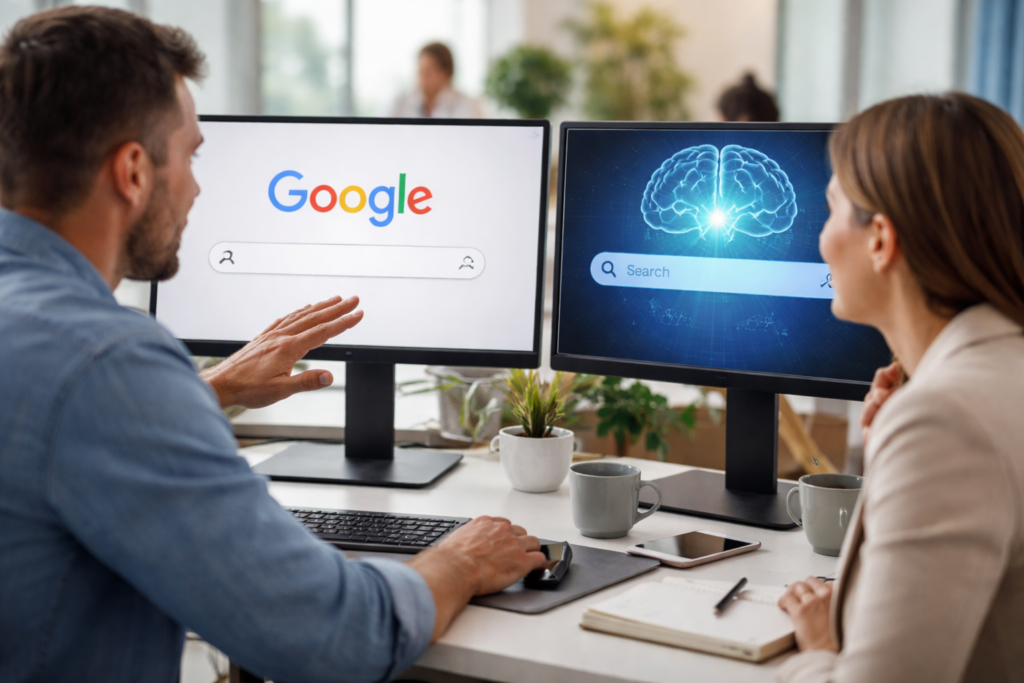
The fight for search visibility is no longer limited to blue links on Google. Today, AI search, AI overviews, and other AI systems are creating a new layer of discovery where users often receive direct answers before they ever click a traditional result. For law firms and legal marketing agencies, that change affects how a brand appears, how trust is built, and how prospects move from question to contact. Google itself says its AI search experiences are rewarding unique, satisfying content built for real needs, not commodity pages.
This matters because people search differently when artificial intelligence sits between the query and the website. Instead of scanning ten search results , a user may read AI summaries, compare cited sources, and decide which brand seems most credible from the answer itself. That means firms can no longer rely on traditional search alone. They need visibility in both traditional search results and emerging AI results.
For legal marketers, the issue is not whether seo still matters. It does. The issue is how traditional seo must evolve when large language models, answer engines, and AI tools reshape user behavior. The firms that stay visible will be the ones that understand how content ranks, how authority is inferred, and why reliable context now matters as much as raw position.
How Google AI Tools Are Changing Search
Google has made clear that its AI search experiences favor content that is helpful, distinctive, and satisfying for visitors. In practical terms, that means shallow pages, recycled explanations, and thin content are less equipped to compete when AI systems look for strong source material. As Google expands these experiences, the quality bar rises because the answer engine needs grounded, useful content to cite and summarize.
At the same time, other platforms are accelerating the shift. Bing’s generative search and Copilot Search use AI to assemble synthesized responses while still linking to source pages. Microsoft has also introduced AI performance reporting in Bing Webmaster Tools so publishers can see when their pages are cited in AI-generated experiences. That is a strong signal that AI visibility is becoming a measurable channel, not just a theory.
OpenAI’s search experience adds another layer. ChatGPT search gives answers with links to web sources, which means websites can influence discovery even when a prospect never starts on Google. For law firm marketers, this expands the competitive field. The modern search landscape is no longer one engine, one ranking page, and one click path.
Why Traditional SEO Still Matters as AI Answers Rise
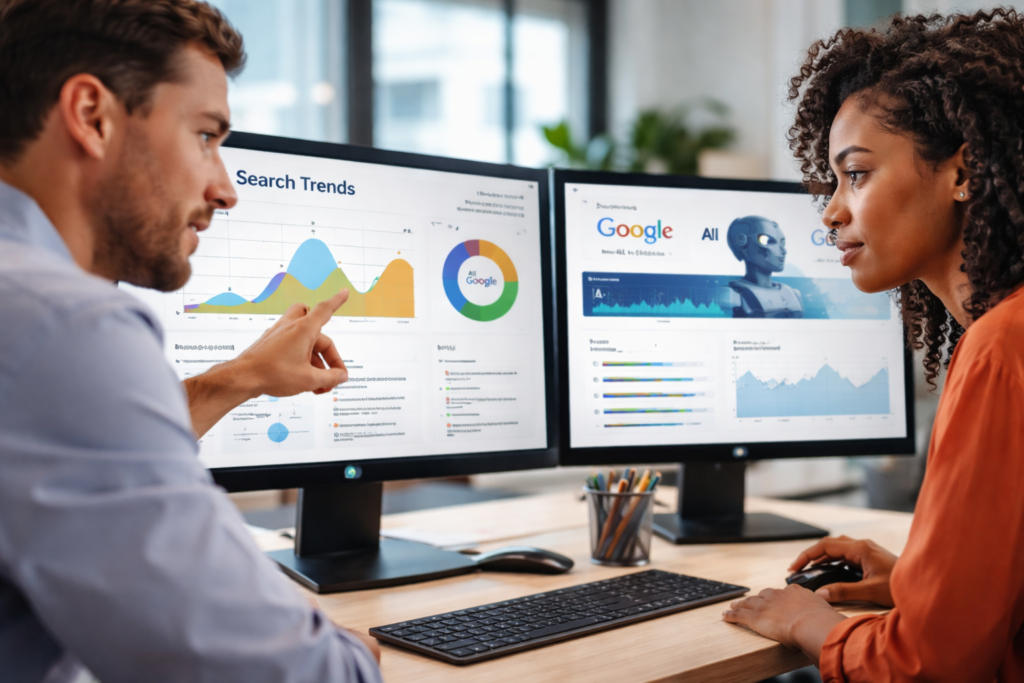
It is easy to assume that ai generated answers make traditional seo obsolete, but that is the wrong conclusion. AI systems still depend on the open web, reliable pages, and strong source signals. If a legal site is weak, vague, or technically messy, it becomes harder for both classic search engines and answer engines to trust it. The foundation still starts with a solid site.
That is why Google rankings still matter. Strong rankings increase the odds that a page gets discovered, crawled, trusted, and used as a source across different search experiences. Even when a user reads an AI summary first, the sources behind that summary still come from pages that demonstrated relevance, clarity, and authority in the broader ecosystem.
For law firms, the smarter view is not Google versus AI. It is Google Plus AI. Firms need content that performs in traditional search results while also being structured clearly enough for AI models to interpret, summarize, and cite. That is the real strategic shift.
Why AI Answers Reward Clarity, Context, and Real Questions
AI systems respond especially well to content that addresses real questions in plain language. Legal marketing pages that bury the main answer under fluff, vague brand talk, or unnecessary repetition make it harder for AI systems to pull clear meaning. In contrast, a page that states the issue, explains the answer, and supports it with context is easier to surface in both search and AI environments.
This is where natural language becomes powerful. People now ask longer, more conversational questions, and Google has publicly said that users in AI search experiences are asking more specific and follow-up questions. Legal content that mirrors that behavior is better positioned for modern discovery because it matches how users actually ask for help.
For legal brands, this means every important page should solve a clearly defined problem. Each example, explanation, and proof point should support comprehension. AI is not rewarding noise. It is rewarding pages that can be understood, trusted, and quoted with minimal confusion.
Why Schema Markup Helps Search Engines Understand Legal Pages
Search platforms use structured data to read a page with more precision, especially when the markup accurately reflects what users can actually see on the site. While schema markup does not automatically improve rankings or guarantee enhanced visibility, it can make a page easier for search systems to interpret and organize. For legal marketers, that matters because clearer classification of services, FAQs, organizations, and page topics can support a stronger understanding across both traditional search and AI-driven discovery.
Google also warns that markup must reflect visible content and comply with quality guidelines. In other words, structured data should clarify what is already true on the page, not exaggerate it. That principle matters even more in legal marketing, where credibility is fragile and overstating claims can weaken trust signals rather than improve them.
A law firm that uses schema markup thoughtfully can strengthen how search engines understand its websites, attorneys, FAQs, and services. That supports both classic seo and the broader machine-readable context that newer AI interfaces use when assembling responses.

Why Google Business Profile Still Shapes Local Visibility
For law firms serving cities or regions, Google Business Profile remains one of the most important visibility assets on the web. Local prospects often begin with service-plus-location searches, and those searches still produce map-driven results, reviews, and profile details that influence first impressions. Even in an AI-influenced environment, local trust begins with accurate profile data.
Google’s business guidance emphasizes accurate representation, correct categories, and reliable details. That matters because local legal discovery is highly sensitive to trust. If a profile looks incomplete, inconsistent, or weakly maintained, the brand can lose credibility before the user even reaches the site.
For legal marketers, local optimization is not separate from AI visibility. It contributes to the broader reputation layer that helps a brand appear consistent, legitimate, and locally relevant. That is especially important for local businesses competing in high-intent markets.
Why Brand Mentions, Digital PR, and Authority Matter More in AI Search
AI systems do not evaluate pages the way humans do, but they still rely on patterns of credibility. When a legal brand earns brand mentions across reputable sources, digital pr coverage, citations, and contextual references, it creates a stronger footprint for machines to recognize. That footprint can influence whether a firm is perceived as established and worth surfacing.
This is where authority becomes broader than backlinks alone. A firm mentioned in trusted articles, community coverage, industry commentary, and relevant discussions builds a stronger signal web than a firm relying only on isolated optimization. In the AI era, being mentioned in meaningful contexts can help reinforce legitimacy.
For legal agencies, that means the visibility strategy must include off-site reputation building. Strong links still matter, but so do broader trust patterns. The firms that stay ahead will treat brand recognition, editorial presence, and contextual mentions as part of a modern search strategy, not a side project.
Why Reddit, Forums, and Discussion-Driven Credibility Influence Discovery
One of the most visible shifts in modern search is the growing role of discussion-based sources like Reddit. Users often want perspectives, experience-based commentary, and less polished language when they research legal questions or marketing vendors. That changes the discovery environment because conversational content can shape expectations before the user reaches a formal brand page.
For law firm marketers, the lesson is not to chase forums blindly. It is important to understand that credibility now comes from multiple layers. Official pages, earned media, structured profiles, reviews, and public discussion all contribute to how a brand is understood across the search landscape.
That broader context affects AI too. If users repeatedly look for discussion-style validation, then brand trust is shaped by more than polished copy. Firms should create content that is reliable, human, and genuinely helpful so it can compete in an environment where users compare official claims against broader public signals.
What Weakens AI Visibility: Thin Content, Weak Context, and Poor Structure
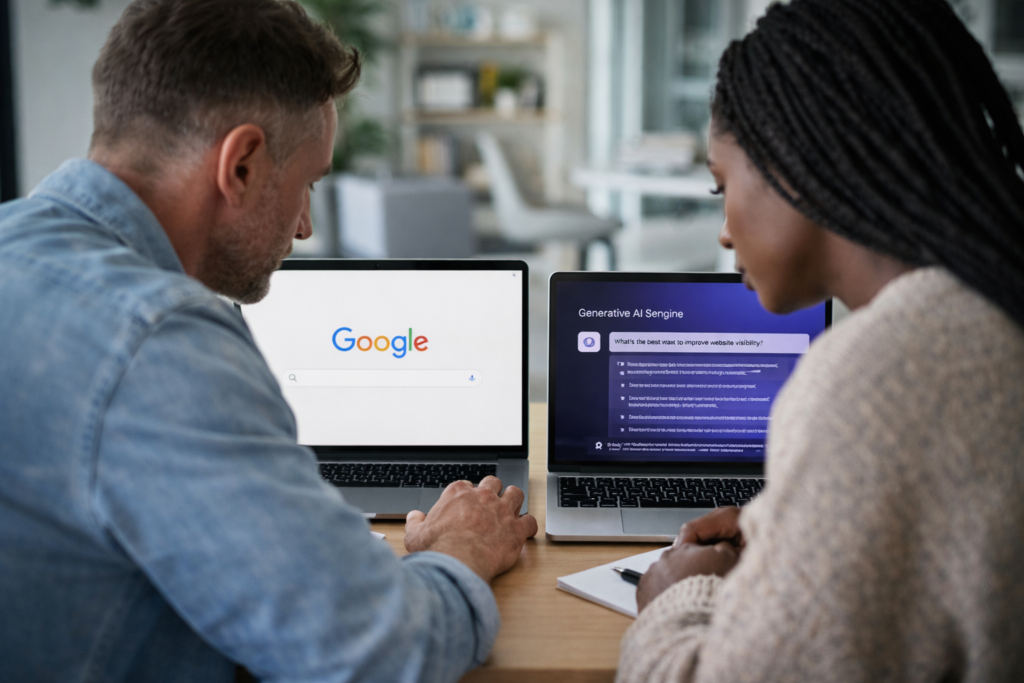
The biggest obstacle to AI visibility is not a lack of tools. It is a weak content architecture. Pages that say very little, repeat keywords, or offer generic summaries do not give AI systems enough substance to work with. When the meaning is thin, the odds of being used for AI answers drop.
Poor structure causes a similar problem. If headings are vague, the main point is buried, and supporting data is absent, the page becomes harder to parse. AI systems favor content that can be segmented cleanly, grounded in useful detail, and connected to a specific intent.
Legal marketers should treat every core page as source material, not just sales copy. That mindset changes how content is written, organized, and refreshed. It also helps stay visible as the discovery model keeps shifting.
How to Optimize Legal Content for Google and LLM Visibility
The strongest approach is dual-purpose optimizing. Build pages that can rank in traditional search and also serve as reliable source material for large language models. That means answering the question early, using descriptive headings, adding supporting context, and making the page easy to scan without turning it into disconnected bullet points.
It also means publishing content that is genuinely worth citing. Google recommends unique, non-commodity content for success in AI search experiences, and that guidance applies directly here. Legal marketers should create pages with original framing, practical explanations, and updated details instead of recycling industry boilerplate.
Finally, every important page should be technically clean, mobile-friendly, and easy to trust. When the content, structure, and technical signals align, the page is better positioned for both ranking and LLM visibility.
The Strategic Shift: From Rankings to Total Visibility
The real shift is strategic. For years, legal SEO focused heavily on rankings, clicks, and organic traffic. Those metrics still matter, but they no longer describe the full picture. A firm can influence discovery through AI answers, cited summaries, local profiles, editorial mentions, and other surfaces where the user may engage with the brand before a traditional click happens.
That changes how agencies should measure success. Position still matters, but so do citation presence, source visibility, branded search growth, and off-site trust signals. Bing’s new AI performance reporting makes that point especially clear by showing citations as a distinct measurement layer.
For ROI-focused legal marketers, the implication is simple. The goal is no longer just to rank. The goal is to be present wherever potential clients look for trustworthy answers.

FAQ
Is traditional seo still worth investing in if AI search keeps growing?
Yes. Traditional seo still provides the technical, content, and authority foundation that AI systems rely on when they look for trustworthy sources. Strong rankings, clean structure, and reliable pages still increase the odds that your content will be discovered and cited.
Does schema markup improve AI visibility directly?
Not directly in a guaranteed way, but it helps search systems understand page content more clearly. Google says structured data can help it understand content and support rich results when guidelines are met, which makes it a valuable clarity signal.
Why does Google Business Profile still matter if users get direct answers?
Because local legal discovery still depends heavily on trust, geography, and profile accuracy. Even when users see AI summaries first, they often validate firms through local profiles, reviews, and map results before making contact. A strong profile remains a major trust asset.
Conclusion
The new contest for online visibility is not a temporary trend. Google AI, AI overviews, ChatGPT search, and other answer-driven experiences are reshaping how firms get found, evaluated, and remembered. Traditional seo still matters deeply, but it now works alongside AI search, source citation, local trust, and brand-level authority.
Law firms that want to stay ahead should strengthen core seo, improve schema markup, protect their Google Business Profile, invest in digital pr, and publish content built around real questions with reliable context. That is how a firm protects rankings while expanding into newer forms of visibility.
If your firm wants a clearer strategy for this changing search environment, ROI Society can help you assess where your brand stands across Google, AI discovery, and local authority signals. Request a strategy call or visibility audit and build a legal marketing system designed for where search is going next.